カオリさんの「私の見方」
Japanese🇯🇵|↓ENG🇬🇧|↓↓PT−BR🇧🇷
こんにちは, アンサーノックスのクララです。
楽しい節分過ごしましたか?
2026年2月3日、山梨県民が朝刊の山梨日日新聞を受け取ると、18ページの「私の見方」欄に見慣れた顔が印刷されていた。
今回見方をシェアする人は誰でしょうか?
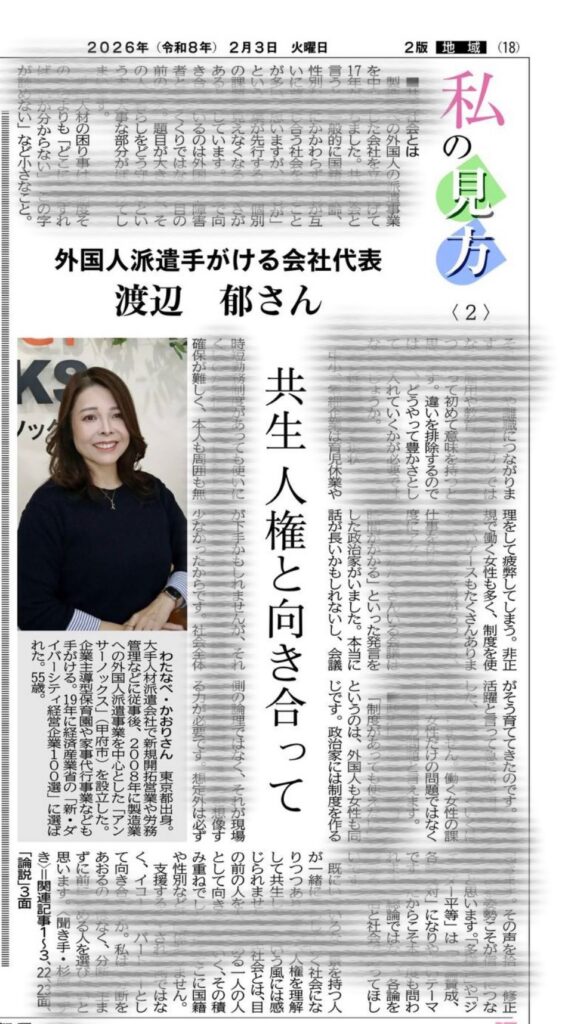
「カオリさん」と推測した方は正解です。
カオリさんはコラムのスペースを利用して、次の選挙の希望とビジョンを広めました。
カオリさんは、平等な社会への道には構造的な変化が不可欠だと信じています。
この記事は、「共生社会」という言葉の裏側にある現実を、丁寧に問いかけています。
私たちはつい、うまくいかないことがあると「本人の努力」や「能力」の問題だと考えがちです。
けれど本当にそうでしょうか。
同じスタートラインに立てていない人に、同じ結果を求めることは、公平なのでしょうか。
この記事が伝えているのは、問題は個人だけではなく、制度や慣行、社会の前提そのものにもある、という視点です。
誰かがつまずいたとき、「なぜできなかったのか」ではなく、
「社会は何を準備できていなかったのか」を考えること。
カオリさんは、より深い傷にバンドエイドを貼るだけの行為ではなく、社会システムを変えることができる対策を講じることの重要性について語りました。
最近は誰もが多様性について良い言葉を使いたがりますが、それを実現するための具体的な方法については考えていません。
コラムを全部皆さんにシェアしたいのですが、できないので、ここにリンクを残しておきます。
「私の見方」というコラムはカオリさんの見方についてでしたが、この機会にクララの見方についても少しお話させてください。
社会の将来に対する希望を考えるとき、ピラミッドの底辺にいる人々の生活の質を高めれば、自動的に全員の状況が改善されるだろうと主張する思想家に私は深く同意します。
一番下のリンクを上げれば、それに応じて上のリンクもすべて上がります。
山梨日日新聞購読者の皆さんは、ぜひ私よりもずっと雄弁カオリさんの見方をチェックしてみてください。
長い間ロダンの彫像を真似していた後、クララが立った。
[ENGLISH TRANSLATION]
Hello, this is Clara from Answer Knocks.
How did you like your Setsubun?
On February 3, 2026, when the residents of Yamanashi Prefecture received their morning edition of the Yamanashi Nichinichi Shimbun, they found a familiar face printed in the “My View” column on page 18.
Who do you think was sharing “their view” this time?
Well, if you guessed “Kaori,” you’re correct.
She used this plataform to share her views and hopes for the upcoming election.
Kaori believes that structural change is essential to the path to an equal society and her article carefully questions the reality behind the phrase “coexistence society.”
That’s because normally, when things don’t go well, we tend to think that it was due to a problem of the individual’s “effort” or “ability.”
But is that really the case?
Is it fair to expect the same results from people who don’t start from the same starting line?
This article conveys the perspective that the problem lies not just with individuals, but also with systems, practices, and the very assumptions of society.
She thinks we ought to question “What is lacking in our society for that individual to bloom” instead of “How come did they fail?”
Kaori spoke about the importance of taking measures that can change the social system, rather than simply putting a Band-Aid on a deeper wound and announce to everyone that you fixed the problem.
These days, everyone wants to use beautiful words like “diversity” in their speech, but people hardly want to think about specific ways to make it a palpable reality.
I would like to share the entire column with you, but since I can’t, I will leave the link here.
The column was about Kaori’s view, but I would like to take this opportunity to talk a little about My View as well.
When I think about my hopes for the future of society, I deeply agree with thinkers who argue that improving the quality of life for those at the bottom of the pyramid will automatically improve the situation for everyone and that if you raise the bottom link, all the links above will rise accordingly.
Yamanashi Nichinichi Shimbun subscribers, I encourage you to check out Kaori’s View, which is far more eloquent than mine.
After a long time imitating Rodin’s statue, Clara stood up.
[TRADUÇÃO PARA PORTUGUÊS]
Olá, aqui é a Clara da Answer Knocks, curtiram bastante o Setsubun?
Nesse dia 3 de fevereiro de 2026, quando os moradores de Yamanashi receberam sua edição do Yamanashi Nichinichi Shimbun pela manhã, encontraram um rosto familiar impresso na coluna “Minha Opinião”, na página 18.
Quem você acha que estava compartilhando “sua opinião” desta vez?
Bem, se você chutou “Kaori”, acertou.
Ela usou essa plataforma para compartilhar sua visão sobre a próxima eleição.
Kaori acredita que a mudança estrutural é essencial para o caminho rumo a uma sociedade igualitária e seu artigo questiona a realidade por trás da tal “igualdade social”.
Isso porque, normalmente, quando as coisas não vão bem, é muito fácil apontarmos o dedo para a pessoa que falhou e questionar sua capacidade individual, mas será que essa é mesmo a questão?
É justo esperar os mesmos resultados de pessoas que não partem do mesmo ponto de partida?
Kaori fala que o problema não reside apenas nos indivíduos, mas também nos sistemas, nas práticas e nas próprias premissas da sociedade.
Ela acha que devemos questionar “O que falta em nossa sociedade para que esse indivíduo floresça” em vez de “Por que essa pessoa fracassou?”.
Kaori falou sobre a importância de tomarmos medidas que mudem o sistema de base, em vez de simplesmente colocarmos um curativo em uma ferida profunda e anunciar de boca cheia que resolvemos o problema.
Hoje em dia, todos querem usar palavras bonitas como “diversidade” em seus discursos, mas as pessoas raramente querem pensar em maneiras concretas de garantir essa diversidade.
Eu gostaria de compartilhar a coluna inteira com vocês, mas como não posso, vou deixar só o link.
A coluna era sobre o ponto de vista da Kaori, mas gostaria de aproveitar esta oportunidade para falar um pouco sobre a Minha Opinião também.
Quando penso no que eu quero para o futuro da sociedade, não consigo deixar de concordar com os pensadores que argumentam que melhorar a qualidade de vida daqueles que estão na base da pirâmide social melhorará automaticamente a situação de todos e que, se elevarmos os elos mais abaixo, todas oss elos acima virão por tabela.
Assinantes do Yamanashi Nichinichi Shimbun, recomendo que leiam o artigo com a visão da Kaori, que é muito mais eloquente que o meu.
Depois de muito tempo imitando a estátua do Rodin, Clara ficou de pé.